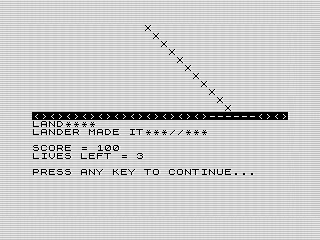
I couldn’t leave well enough alone. All that analyzing and nitpicking of the original Space Lander made me wonder what it might be like if I had rewritten it. Almost 28 years later, here is the reborn version of Space Lander 2011.
I couldn’t leave well enough alone. All that analyzing and nitpicking of the original Space Lander made me wonder what it might be like if I had rewritten it. Almost 28 years later, here is the reborn version of Space Lander 2011.
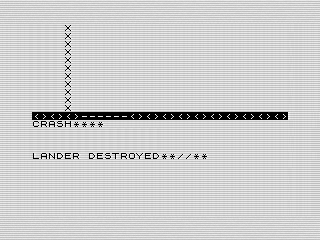
Okay, this may not be the large program I promised, but I choose Space Lander for a different reason: it's horrible! Okay, maybe it isn’t that bad, but it definitely wasn’t one of better programs. This was from 1983, clearly one of my earlier attempts. Actually, it is kind of refreshing reminder how much better my programming has become. If this helps others learn, then by all means check out the listing.
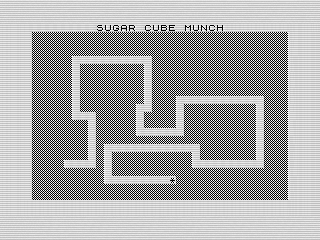
Another simple program. Like many that I wrote for the ZX81, Sugar Cube Munch was small with a singular purpose. In this case, the goal is to eat all the cubes of sugar as quickly as possible. Once all the sugar is eaten, the game is over and the number of turns is revealed. You can give it a try by using the ZX81 arrow keys 5,6,7, and 8 to move around.

I’ve been a bit busy this month so I choose a relatively short program in order to not miss my self imposed deadline. To that end, I present to you April’s belated graphic program: Sphere. This program will easily run on a 2K ZX81. With some trimming, if you are so inclined, it will probably run in the original 1K of RAM as well. Although I doubt too many people with a ZX81 have less than 16K of RAM. Take a look at the listing to get a feel for how small this program really is.
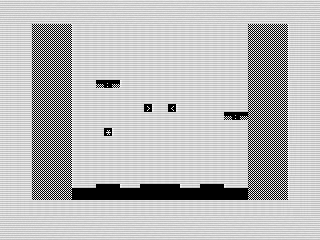
March’s program is Lock £ Fire. I wrote this graphic game in 1985, although I have to admit I don't remember it much. It is a bit hard to play as the keys aren’t very sensitive and the aliens jump around as you try to “lock” onto them. It doesn’t help that I used an odd keyboard layout which adds to the difficulty. The aliens are shooting at your shield and, if they get through, the game is over. Note that you don’t kill the aliens, but they may change their look. When you shoot them enough, the next level starts. Every 10 hits will clear some of your shields as well. Boy, I must have been in one of those moods when I wrote this.

For some time now I’ve listed the ZX81 books I own on my original ZX81 web site, but I hadn’t put much effort in searching the web for them. Mainly this was because I already own them, but mostly because it never occurred to me to do so. I ran across an online copy of Sinclair ZX81 BASIC Programming which made me wonder what other books existed out there. Sadly, my search uncovered very little legitimate books. However, World of Spectrum did have a good number of the books and cover art available.
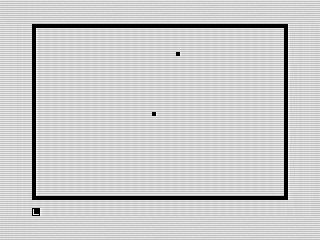
This month’s program is a simple game of Golf. Although not overly exciting, it does show off a few ZX81 BASIC features.

I did it! After a lot of recording, cleaning, and tweaking I was finally able to get Water Bug II loaded! Hit the link, wait for it to load, then hit enter to give it a whirl. Then use the 5, 6, 7, and 8 keys to move (left, down, up, right) just as they are on the ZX81 keyboard.
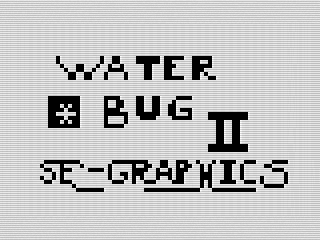
I really meant to have a number of my programs converted this month. I found a tape player and have been trying to load my ZX81 programs off the original tapes; however, I keep running into a problems.

I really haven’t liked the way the code routine displays on my blog. It adds a lot of white space and generally looks bad. To make things a bit nicer, I removed the Code: message, set the overflow to auto instead of scroll, and I removed the extra breaks.
One thing that always bugged me with using scripts is that you tend to see the script name. For example, this site has always had an index.cgi and most PHP sites have index.php in the links. I find it tacky and many commercial sites don’t do this. I don’t want to change my software, so there has to be a way around this problem. The search is on!
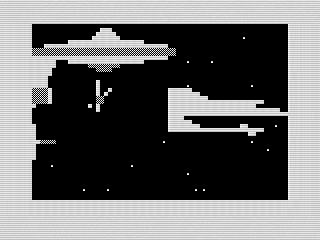
A few years back, I started to convert some of my old ZX81 programs so they could be use in various ZX81 emulators. That project was mostly my way of trying to preserve some printouts from my now faded programs. I was curious if I there was a way to emulate those programs in a web site. Surprisingly, the answer is yes!
I noticed a few errors with my 360voice Dynamic Userbars today, so I decided I should probably fix them. One was with my watched list. I limit the list to 20, but it wasn’t actually working properly for users not watching anyone. The other bug was in challenges where it would stop displaying members after it found the callers gamertag. Fortunately, both were easy fixes.
Must be a coding night for me, as I’ve been cleaning up a few things and fixing bugs. First up, I’ve been tweaking the way the tags display on the site. I added the ability to limit the tag cloud display and then did just that in the plugin. Now, only the top 25 tags show. I also now sort case insensitive. I also added a “View All Tags” link, since I don’t display all the tags by default.
As much as I use the 360voice.com data, I thought it only fitting to give back. So, today I launched 360voice Dynamic Userbars. If you’re a 360voice user and like userbars, show your pride by adding one of these images to your forum signatures.
This is pretty cool. Hawty McBloggy blogged about a site that generates some spawn time stats (Halo 3 - Time Wasted Respawning). The script is interesting. But more interesting was that it makes use of a Halo API.

Due to issues Ive been having where Xbox Live!’s gamer card, I've converted my gamer card to one from MyGamerCard.net. Recently, it appears that Xbox Live! has been requiring you to sign into their site before showing someone’s gamer card.
I’ve been using the tag cloud concept on a lot of other sites and find it useful at times. The idea is pretty simple, supply keywords or tags to your content. Those tags are then counted and a tag cloud of links is displayed, with more frequent links larger then less frequent ones. Since my site was lacking in that capability, I decided to program it in.