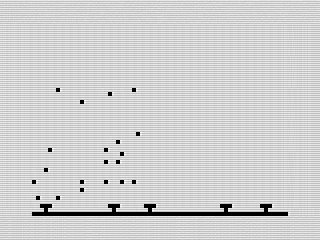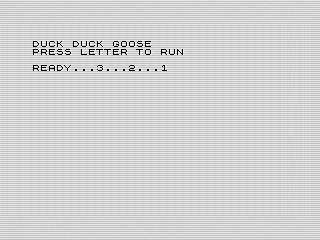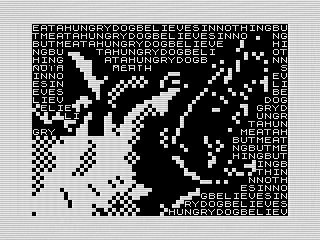
Every once in a while, a small, silly idea turns into a surprisingly fun little project. That’s exactly what happened with my latest ZX81 experiment, a reaction-based game inspired by the old nursery rhyme: Duck, Duck, Goose.
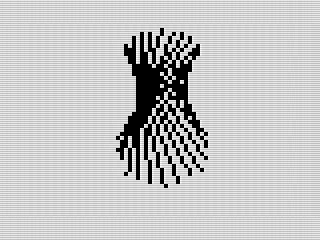
I wrote this back in August and I’m finally getting around to publishing it. It was first shared in my BASIC group, but the ZX81 lacks a lot of the functionality needed for it to run well. Undeterred, I hacked at the program to not only display the twisted cylinder, but also add a bit of randomness to the demo.
After updating my print scroll routine, I started thinking about how I could use it to create a different version of my infinite maze program. The original used graphic characters and spaces since the ZX81 lacked a backslash. This new version takes a different approach, using alternate graphics to build a more visually interesting maze while leveraging a better machine scrolling routine.
I’d read about and studied cellular automata but had never programmed any simulations for them. Conway’s Game of Life is the go-to simulation and something others had already implemented on the ZX81, even when I was a kid. I finally got around to typing in some of those programs but found them slow. My version aims to correct that.
Another year and another Vintage Computing Christmas Challenge (VC3 for 2024). I rushed a bit to get mine in so I do feel it wasn’t as short as possible. I did take a somewhat unique route to solving the problem which makes the build more interesting. I made an auto-run version for Present so you could see it in action.
Sometimes, you do things out of necessity. I spent an inordinate amount of time working on adding automatic scrolling to a PRINT command. In fact, I haver another version of my print scroll routine I’ll talk about later. But this is about a utility program. A way to print out BASIC code in hex. And this article is about what I did and why.
Finding inspiration again from my programming groups, the idea of an infinitely scrolling screen of text came up. There were a couple of different solutions posted, some quite ingenious. I had done something similar in the past, but this time I used a bit of machine code magic to create a more flexible solution. The result is Print Scroll.
Something I’d been itching to do is write a maze generator. Even though they seem simple enough, for some reason, I struggled to code one. With so many different algorithms out there, the sheer number of choices can be overwhelming. It wasn't until I took a vacation that my mind settled down enough for me to finally tackle the task.
I had forgotten about this Black Hole program until I ran across it while cleaning up some directories. It is a conversion, not an original, program that was shared on one of my BASIC forums. It doesn’t look quite as good as the original, but it was interesting to see what the ZX81 could do with its simplistic graphics.
While on vacation, I spent some relaxing time converting my Kimmie Fish BASIC program into something a bit more interesting. In addition to the normal speed improvements, I wanted to give it an aquarium like feeling with bubbles and depth. No color here, this is all stock ZX81 graphics. Only thing needed is the requisite 16K memory pack.