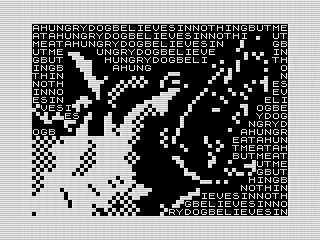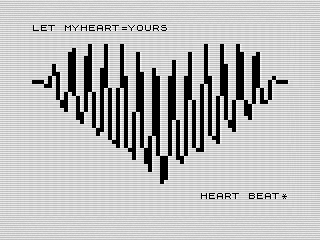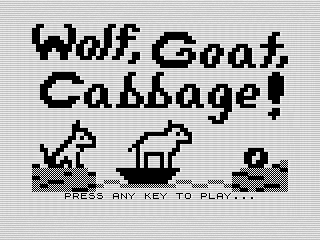
When I first converted Wolf, Goat, Cabbage to the ZX81, I wanted to include an intro screen. Sadly, I didn’t get around to it at the time. This month, I finally circled back and it turned into quite the journey.
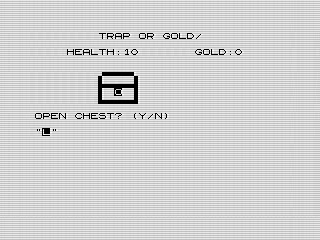
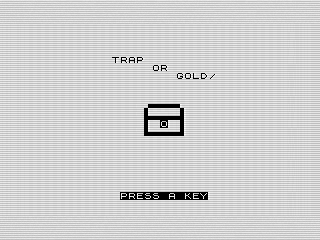
I was pursuing ideas for a simple role-playing or fighting game. The one I landed on was the concept of a single treasure chest. It fit the retro-computing theme perfectly. Trap or Gold is a simple game that doesn't need fancy graphics, speed, or memory — yet it’s still fun.
I recently got back into retro hardware. My starting point was gaming, as I ordered one of the new Atari 7800s that plays the old cartridges. In my haste to grab a few games, I inadvertently purchased a complete 2600 with controllers. I’ll blame travel and lack of sleep for missing that detail. But it gave me the opportunity to attempt something I’ve never done before: restore the controllers.
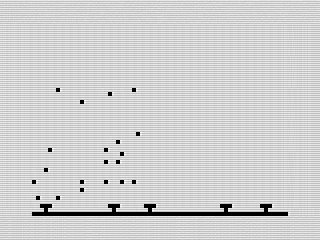
Every once in a while, a small, silly idea turns into a surprisingly fun little project. That’s exactly what happened with my latest ZX81 experiment, a reaction-based game inspired by the old nursery rhyme: Duck, Duck, Goose.
I’d been thinking about writing a better clock program for the ZX81 for some time but never acted on it. That is, until yesterday when I saw a flip-style digital clock program on the C64. The result is a sort of digital flip clock program for the ZX81 that ended up being quite a fun journey.
I thought I’d try something a bit different this month. I’d been looking at different ways to build maps for years but never really did much with them. After watching a video on binary partitioning, I decided to see if I could build a simple map builder on the ZX81.
This is the result.
I wrote this back in August and I’m finally getting around to publishing it. It was first shared in my BASIC group, but the ZX81 lacks a lot of the functionality needed for it to run well. Undeterred, I hacked at the program to not only display the twisted cylinder, but also add a bit of randomness to the demo.
I’d seen a few different BASIC programs that print out a map of the world. Generally blocky, they still looked decent, but much of the data was too big for the ZX81—until I ran across a C64 version based on a Spectrum program. Examples in hand, I built a version for the ZX81.
Having finished my last Truchet tiles program in BASIC, I wondered how fast it would run in machine code. Soon afterward, I gave it a try, writing a version that runs significantly faster than the BASIC one. Let’s dive in and see how it works.