Are You Fast Enough to Beat My ZX81 Duck, Duck, Goose Game?
A fun ZX81 BASIC reaction game inspired by Duck, Duck, Goose, using randomness and timing to challenge your reflexes.
Every once in a while, a small, silly idea turns into a surprisingly fun little project. That’s exactly what happened with my latest ZX81 experiment, a reaction-based game inspired by the old nursery rhyme: Duck, Duck, Goose.
The rhyme always felt like a game waiting to happen. Someone walks around, calmly tapping heads, saying “duck… duck… duck…” and then suddenly — goose! Everything changes in an instant. That moment of surprise is perfect for a computer game, especially on a machine like the ZX81 where timing and simplicity are part of the charm.
I started with the story in my head: the computer steps through the ducks, and at some random point it shouts goose. Your job is simple — react fast enough and hit the right key before it’s too late.
Simple idea. Tricky execution.
# From rhyme to reaction.
At first, I built it in the most obvious way. The program runs through the ducks, waits, and when it hits goose you press a key to win. While testing, I immediately found a problem. I could beat it every single time by just holding the winning key down.
Not being any fun, I added a check to make sure you weren’t already pressing the key. Although it helped a little, it didn’t fix the problem. I could still cheat by holding the key, letting the program pause before the reaction window, and then hitting it again to win.
Back to the drawing board.
# Making it harder to cheat.
The real fix turned out to be simple and much more interesting: don’t tell the player which key will win.
Instead of waiting for one predictable input, the program now picks a random key when goose happens. That means you can’t camp on a button anymore — you actually have to react, see what’s being asked, and respond in time.
The side effect?
It’s harder. Sometimes really hard.
But that’s what made it fun.
Suddenly Duck, Duck, Goose stopped being a timing trick and turned into a proper reaction test. You have to be fast enough to win. I adjusted the timing a bit to ensure the game felt fair, yet challenging. On a ZX81, that kind of tension feels great. The machine isn’t rushing you with graphics or sound; it’s just quietly waiting to see if you’re quicker than it is.
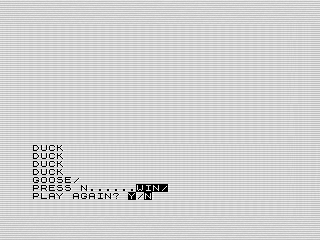 Duck Duck Goose Win Screen, ZX81 Screenshot, 2026 by Steven Reid
# Programming a game.
Under the hood Duck, Duck, Goose is classic ZX81 BASIC. The program flow is as follows:
- It steps through the ducks.
- Randomly decides when goose appears.
- Chooses a random winning key.
- Opens a short reaction window.
- Checks if the correct key is pressed in time.
- Then decides your fate.
Nothing fancy, just timing, randomness, and keeping the player honest. Because of the randomness, I used SCROLL to avoid filling up the display.
# Can you beat it?
Of course, the real question isn’t how it works — it’s whether you’re fast enough. No save states. No rewinds. Just you, the ZX81, and a surprise goose waiting to ruin your day.
- Sometimes you’ll win.
- Sometimes you’ll swear you pressed the key in time.
- And sometimes the goose just gets you.
Which feels pretty accurate to the playground version, honestly.
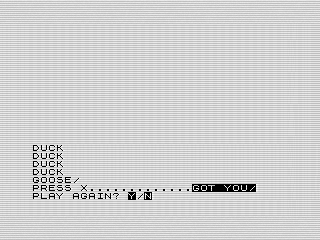 Duck Duck Goose Lose Screen, ZX81 Screenshot, 2026 by Steven Reid
# Final thoughts.
I like projects like this. They start with something small — a nursery rhyme, a silly idea — and turn into a little experiment in game design. Even on a 40-year-old machine, you still run into modern problems like cheating, fairness, and player feedback.
Duck, Duck, Goose ended up being more than a joke program. It’s a tiny reaction challenge wrapped in a bit of childhood nostalgia, running on hardware that still surprises me with what it can do.
So… are you fast enough to beat it?
---
Want to try it out? You can run the program, or view the code if you’d like to see how it works.